
What buying a house costs on top of the price in Costa Rica
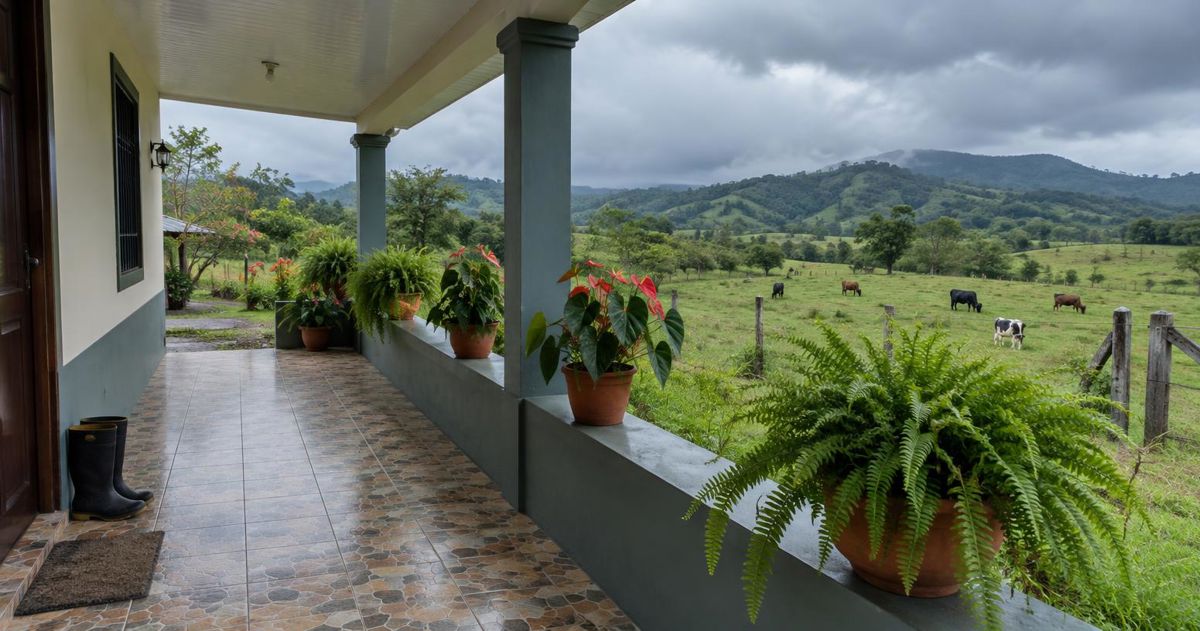
Buying a house in Costa Rica costs more than the agreed price: the transfer pays a tax, the registration pays registry duties and stamps, the notary charges under a mandatory fee schedule and, if there is a loan, the bank adds appraisal, fees and insurance. This guide explains each cost, who pays it under the law and how to estimate the total before signing, both for buyers paying with their own funds and for those buying with a mortgage.
How much does buying a house cost on top of the price?
| Type | Median | Typical range | Price per built m² | Listings |
|---|---|---|---|---|
| Houses | US$283k | US$190k – US$480k | US$1,268 | 8,263 |
| Apartments | US$190k | US$145k – US$290k | US$2,048 | 2,521 |
In Costa Rica, the price agreed with the seller is only part of the outlay. At closing come the taxes and duties the State charges for the transfer and its registration, the stamps on the deed, the notary's fees and, if the purchase is financed, the costs of the mortgage loan. After signing begin the costs of being an owner, such as the municipal tax. Anyone browsing homes for sale in Costa Rica should set aside, from day one, a separate budget for these items and not confuse it with the down payment the bank asks for.
The table in this section shows the prices being asked this month for houses and apartments for sale across the country. They are asking prices in listings, not closed sale prices, but they are a starting point: almost all closing costs are calculated on the value declared in the deed, so the same procedure costs more the higher that value is. The breakdown by province and canton is on the page of home prices in Costa Rica, useful for locating the range of the area you are interested in before running the numbers.
Almost all of these costs are calculated as a percentage or a rate on the value stated in the deed, and several have a minimum or are charged by brackets. The table below summarises each item, the base on which it is calculated and who pays it when the parties agree nothing else. The sections that follow explain each one with its legal source, so you can compare the notary's estimate with what the rule says.
| Cost | Base or rate | Who pays |
|---|---|---|
| Transfer tax | 1.5% of the real value of the transaction | Seller and buyer in equal parts |
| Registry duties | ₡5 per ₡1,000, minimum ₡2,000 | Equal parts, unless agreed otherwise |
| Agrarian stamp | ₡1.50 per ₡1,000 | Equal parts, unless agreed otherwise |
| Bar Association stamp | Fixed amount by bracket of value | Equal parts, unless agreed otherwise |
| Notary's fees | Percentage by brackets, minimum ₡60,500 | Equal parts, unless agreed otherwise |
| Mortgage deed | Its own fees, stamps and duties | The debtor |
| Loan appraisal, fees and insurance | According to each lender's terms | The loan applicant |
| Property tax | 0.25% a year of the recorded value | The owner |
Advertisements
How much is the transfer tax and who pays it?
Under articles 1 and 8 of the Real Estate Transfer Tax Law (Law 6999), the transfer of real property, under any title, pays a tax of 1.5%, except for the exemptions the law itself lists. «Under any title» means the legal form in which the property changes hands does not matter: if there is a transfer, the tax applies. Exemptions exist, but they are cases the law itself lists, and it is the notary who must check whether your purchase fits one before signing. Without that check, the prudent course is to budget for the full tax.
Article 6 of Law 6999 provides that the tax is owed by seller and buyer in equal parts, as jointly liable parties, except in a court auction or a transfer in payment of a debt, where the acquirer is liable for all of it. Being jointly liable means the obligation reaches both of them, even if the contract agrees a different split. That is why the deed should make clear who covers which part, and the buyer should verify that payment was made. If you buy at an auction or receive a house as payment of a debt, budget for the whole tax yourself.
The base and the deadline are in articles 4 and 7 of that law: the tax is paid within 15 business days after the deed is executed and is calculated on the real value of the transaction, which must match the usual market value and can never be lower than the highest value recorded for property tax purposes. In practice, declaring a lower value in the deed than the agreed one is not a legitimate saving: the base has a legal floor, and the notary normally collects the tax at signing in order to pay it on time.
What do the Registry, the stamps and the notary charge?
For the purchase to be in your name, the deed is registered at the Registro Nacional. Under article 2 of the Registry Fees Law (Law 4564), registering a property transfer pays registry duties of ₡5 per ₡1,000, that is 0.5%, calculated on the higher of the value given by the parties and the value in the Registro Único de Valores, with a minimum of ₡2,000 per document. As with the transfer tax, the base is not set by the contract alone: if the recorded value is higher than the declared one, the duties are paid on the recorded value.
The deed also pays two stamps. Article 14 of the Agrarian Stamp Law (Law 5792) sets ₡1.50 per ₡1,000 on a property transfer deed, and ₡1 per ₡1,000 for social-interest housing whose value does not exceed the amount set by BANHVI. The other is the Bar Association stamp: under article 108 of the fee schedule for legal and notarial services (Decreto Ejecutivo 41457-JP), it is a fixed amount by bracket of value, exempt up to ₡250,000 and rising to ₡55,000 from ₡500 million; in a transfer, the value used is the higher of the real value and the declared tax value.
The notary's fees cannot be freely negotiated down. Article 74 of that fee schedule sets that, for a sale, the notary charges according to the value and by brackets: 2% up to ₡11 million, 1.5% on the excess up to ₡16.5 million, 1.25% on the excess up to ₡33 million and 1% on the excess over ₡33 million, with a minimum of ₡60,500. Each percentage applies only to the portion of the value that falls in its bracket, not to the whole value, so the correct calculation adds up the brackets one by one. Ask the notary for that breakdown in writing.
Who pays all this? Article 68 of Decreto Ejecutivo 41457-JP provides that, unless the parties agree otherwise or a legal provision says otherwise, the notary's fees, duties, stamps and taxes on an act or contract are paid in equal parts. It is a default rule: seller and buyer can agree a different split in the purchase option or the letter of intent. If the seller proposes that the buyer take on all the costs, that is part of the price negotiation and should be assessed as such.
What does a mortgage loan cost on top of the interest?
If you buy with financing, the bank or the mutual adds its own costs before disbursement. The first is the appraisal: an appraiser from the lender visits the house and sets its value, which is the base for deciding how much to lend. The appraisal is paid even if the loan is not approved, and if the value it gives is lower than the agreed price, the difference comes out of your pocket as an additional down payment. That is why it pays to request the appraisal early, before committing an earnest deposit or a reservation payment to the seller.
Then come the fees and the insurance. Many lenders charge an arrangement or loan-review fee, and almost all require life insurance on the borrower and insurance on the property against fire and other risks, which are paid for the whole life of the loan together with the instalment. These amounts are not set by a common law: they depend on each lender, so offers should be compared on total cost and not only on the interest rate.
The loan also requires a second deed: the mortgage deed, with its own fees, stamps and registration duties. Here the split rule changes: the same article 68 of the fee schedule excludes from equal parts the creation and cancellation of mortgages and pledges, which the debtor pays. In other words, everything it costs to mortgage the house is paid by you as the buyer, as is whatever it costs to cancel the mortgage when you finish paying the loan.
- Cost of the appraisal and whether it is paid even if the loan is not approved
- Arrangement or loan-review fee
- Borrower life insurance and property insurance, with their monthly cost
- Fees, stamps and duties for the mortgage deed
- Cost of cancelling the mortgage at the end of the loan
What is paid after buying, and which costs do not appear in the deed?
Being an owner has a fixed cost: the property tax. Under articles 3, 22 and 23 of the Property Tax Law (Law 7509), it is an annual tax equal nationwide to 0.25% of the property value recorded by the Tax Administration; the municipality administers and collects it, and it is paid in one, two or four instalments as each municipality decides. Before moving in, check with the municipality of the canton how it collects and when each instalment is due, so you can include it in your monthly budget.
Hidden costs are those that do not show up in the deed but do show up in your account. Some appear before signing, such as the registry and cadastral study of the property or a technical inspection of the construction; others come later, such as repairs the viewing did not reveal, connecting utilities in your name or condominium fees if the house is in one. None has a legal rate, so it pays to get quotes before committing and not leave them as surprises.
- Registry study: liens, mortgages or annotations on the property
- Cadastral map that matches what is seen on the ground
- Proof that the seller is up to date with the municipality and utilities
- Technical inspection of the roof, electrical wiring and plumbing
- Outstanding condominium fees and bylaws, if applicable
- Moving, changing locks and immediate repairs
The point that most surprises buyers in Costa Rica is the debts that come with the house. If the seller left municipal taxes or condominium fees unpaid, the collection can end up at the new owner's door. Ask for proof of being up to date before signing, and have the deed or the purchase option state who is liable for any balance prior to the date of sale.
How do you estimate total costs before signing?
A serious estimate is built on the value to be declared in the deed, not on the listing price. With that value in hand, each item is calculated at its rate and added up; then you apply the split you agreed with the seller. The order below avoids leaving any cost out.
- Confirm the value in the deed and ask the notary whether the recorded value of the property is higher, because the base can never fall below it.
- Apply the 1.5% transfer tax to that base and settle which part is yours.
- Add the registry duties of ₡5 per ₡1,000 and the agrarian stamp of ₡1.50 per ₡1,000.
- Ask the notary for the Bar Association stamp amount according to the bracket of value.
- Calculate the notary's fees bracket by bracket and confirm they do not fall below the minimum of ₡60,500.
- If there is a loan, add the appraisal, fees, insurance and mortgage deed according to the bank's cost sheet.
- Set aside the first property tax instalment and a budget for moving and repairs.
With the total ready, ask the notary for a written estimate with each item separated and compare it with your calculation. If a figure does not match, ask on what base it was calculated: the difference is almost always in the recorded value of the property or in a bracket of the fee schedule. Do this check before paying an earnest deposit or signing the purchase option, while you can still renegotiate who pays what.
What we would do
- Set the budget with the price and closing costs together, and search within that real ceiling; if the margin is tight, cheap homes for sale in Costa Rica leave room for the costs.
- Agree in writing, in the purchase option, who pays the transfer tax, the stamps and the notary, without assuming the equal-parts split.
- Ask the bank for the full cost sheet of the loan and compare offers by total cost, not only by rate.
- If closing costs do not fit yet, keep renting while you save: homes for rent in Costa Rica let you get to know the area before buying.
- If the goal is to save faster for the down payment and costs, compare cheap homes for rent in Costa Rica before renewing your current lease.
Frequently asked questions
Can the seller pay the whole transfer tax?
Yes, if they agree to it. The fee schedule's equal-parts rule applies only when there is no agreement, and the parties can distribute the costs as they wish in the purchase option or in the deed. What the agreement does not change is that Law 6999 makes seller and buyer jointly liable for the tax, so the buyer should confirm that payment was made in full and within the deadline, even if it falls to the seller.
Do you pay property tax if the house is your only property?
You may pay less. Article 4 of Law 7509 provides that, if the property is an individual's only property, it pays no tax up to a value equal to 45 base salaries, and pays only on the excess. The benefit is not automatic in every case: ask the municipality of your canton how to apply and which documents it requires, and do so shortly after the purchase is registered in your name.
Can a notary charge less than the fee schedule says?
No. Under articles 1 and 62 of the fee schedule, its rates are mandatory and fees cannot be lower than the minimum percentages or amounts it sets. An offer well below the schedule should get your attention: it may exclude stamps and taxes, which are charged separately, or the work may not be complete. Compare estimates that separate fees from taxes, stamps and duties.
Is it worth declaring a lower value than the real one in the deed?
No. Law 6999 requires the tax to be calculated on the real value of the transaction, in line with the usual market value and never below the highest recorded value, and registry duties also use the higher value. An under-declared value exposes the parties to later claims and, for those buying with a loan, can clash with the bank's appraisal. The apparent saving does not offset the risk.
This guide summarises the practice of buying a home in Costa Rica and the rules in force in October 2026; it does not replace the advice of a lawyer or a notary, who should review your specific case, any applicable exemptions and the final calculation of each cost before you sign.
Advertisements
More in Taxes and Expenses

Finance and Planning, Taxes and Expenses
Transform your monthly expenses into saving opportunities.

Finance and Planning, Taxes and Expenses
Tips to secure your real estate investment during the buying process

Finance and Planning, Taxes and Expenses
Keys to financing your new home without complications
Finance and Planning, Taxes and Expenses
Guide to Financial Decision-Making When Buying Your Ideal Home
Most viewed in Finance and Planning

Finance and Planning, Mortgage Loans
Keys to negotiate better terms on your mortgage

Finance and Planning, Housing Costs
Where US$100,000 buys a lot in Guanacaste

Finance and Planning, Financial Planning
Dollars or colones: where colón buyers face less competition

Finance and Planning, Mortgage Loans
Strategies to optimize your long-term mortgage payment