


Oxcart Day in Costa Rica: history of the carreta and figures
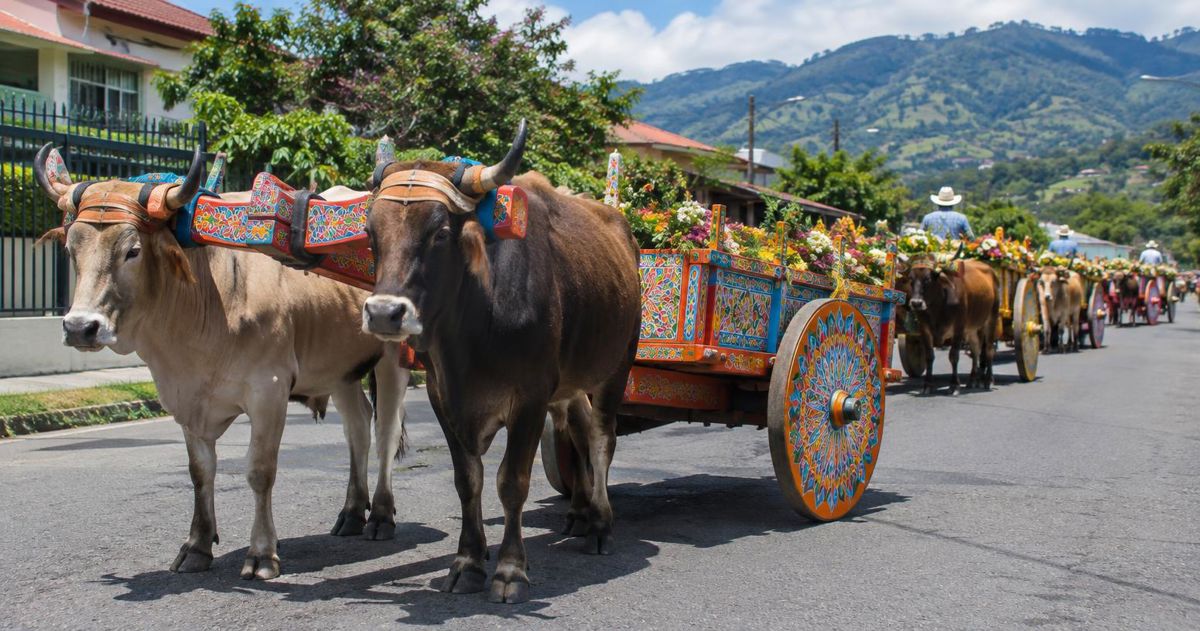
Every second Sunday of March, Costa Rica celebrates the oxcart and oxherding. Here is where the tradition comes from, why each oxcart has its own song and what the official figures say about the working oxen still left in the country.
Where the Costa Rican oxcart comes from
According to UNESCO, the oxcart is Costa Rica's most famous craft. It was born as a means of carrying goods, and over time it became a source of family pride, a folk art and, by decree and by law, a national symbol.
- Mid-19th century, coffee. Oxcarts carry coffee from the Central Valley to Puntarenas, over the mountains: a journey of ten to fifteen days.
- The spokeless wheel. It is a cross between the disc used by the Aztecs and the spoked wheel brought by the Spaniards, made to cut through mud without getting stuck.
- Early 20th century, the paint. Oxcarts begin to be decorated; at first each region had its own design, and the drawings on the wheels told where the driver came from.
- The handover. In most regions, trucks and the train replace the oxcart as the main means of transport.
- 1988, the decrees. On 22 March, Decree 18197-C declares the oxcart a National Symbol of Work; that same year, Decree 18483-C creates National Oxherder's Day.
- 2022, the law. Law 10204 declares the oxcart and oxherding a national symbol of culture, peace and work, and sets their day on the second Sunday of March.
Advertisements
Timeline
| Year | What happened |
|---|---|
| Mid-19th century | The oxcart carries coffee from the Central Valley to Puntarenas |
| Early 20th century | The tradition of painting and decorating oxcarts begins |
| 1988 | On 22 March, the oxcart is declared a National Symbol of Work (Decree 18197-C) |
| 1988 | Decree 18483-C creates National Oxherder's Day |
| 2005 | UNESCO proclaims oxherding and the oxcart a Masterpiece of the Oral and Intangible Heritage of Humanity |
| 2006-2008 | UNESCO funds an 80,000-dollar project to safeguard the tradition |
| 2008 | The tradition enters the Representative List of the Intangible Cultural Heritage |
| 2022 | On 5 May, Law 10204 protecting oxherding and the oxcart is signed |
| 2023 | Escazú celebrates 40 years of its National Oxherder's Day |
| 2027 | Oxcart and Oxherding Day falls on Sunday 14 March |
Working oxen, in figures
INEC's National Agricultural Survey classifies cattle by purpose. Working animals, including the oxen that pull the carts, are just 0.1 % of the national herd.
| Purpose | 2023 | 2024 |
|---|---|---|
| Beef | 901,299 | 909,099 |
| Dual purpose | 322,599 | 279,415 |
| Dairy | 284,904 | 278,709 |
| Work | 1,761 | 2,185 |
| Total | 1,510,563 | 1,469,408 |
| Fact | Figure |
|---|---|
| Journey from the Central Valley to Puntarenas with coffee | 10 to 15 days |
| Length of a traditional yoke for an adult ox | About 66 inches |
| Life of a well-kept yoke | Up to 100 years |
| UNESCO project to safeguard the tradition (2006-2008) | 80,000 dollars |
| Articles in Law 10204 | 8 |
Curious facts
- Each oxcart was made to have its own “song”: the sound of a metal ring striking the hub nut as the cart moves along. The best woods were chosen so it would sound better.
- The cureña cart was the usual one for heavy loads: while Costa Rica had an army, cannons were carried in it.
- In the past, whether an oxcart had a cachimba, the wrench for the wheel nuts, decided whether it was bought or not.
- Law 10204 allows the day to be celebrated throughout the year, as each community decides.
- On the last day of its 2023 celebration, Escazú held an oxherders' parade from the Town Hall to San Antonio square and raffled an oxcart.
Frequently asked questions
Is Oxcart Day a public holiday in Costa Rica?
No. It is not among the public holidays of article 148 of the Labour Code, according to the Ministry of Labour's official 2026 calendar. It is a cultural celebration, and it always falls on a Sunday.
What day is it celebrated?
On the second Sunday of March, under article 2 of Law 10204. In 2027 it is 14 March.
Why does the oxcart sing?
Because of a metal ring that strikes the hub nut with every jolt. According to UNESCO, each oxcart was built to have a unique song.
Sources
- UNESCO: “Oxherding and oxcart traditions in Costa Rica”, Representative List of the Intangible Cultural Heritage (inscribed 2008, proclaimed 2005).
- UNESCO: safeguarding project for oxherding and the oxcart (2006-2008) and the Masterpieces book, proclamations 2001, 2003 and 2005.
- Legislative Assembly: Law 10204, Law protecting oxherding and the Costa Rican oxcart (5 May 2022).
- Legislative Assembly, Technical Services: legal report 121-2011 J, file 18,105 (Decree 18197-C of 22 March 1988).
- University of Costa Rica: “El boyeo en Costa Rica. El apero: una herramienta de orgullo y tradición” (Ediciones Digitales EG, 2025).
- INEC, National Agricultural Survey 2023 and 2024, as reported by CRHoy (29 October 2024) and Revista E&N (23 October 2025).
- Municipality of Escazú and Ministry of Culture: National Oxherder's Day programme, 3-12 March 2023; Ministry of Labour: 2026 holiday calendar.
Advertisements
More in Costa Rica calendar

Lifestyle, Costa Rica calendar
International Men's Day: history and figures for Costa Rica

Lifestyle, Costa Rica calendar
Blue November in Costa Rica: origin, history and figures

Lifestyle, Costa Rica calendar
Black Friday in Costa Rica: housing, loans and renting

Lifestyle, Costa Rica calendar
Costa Rica's Army Abolition Day: history and key facts
Most viewed in Lifestyle

Lifestyle, Urban and Suburban Spaces
Create an urban space that celebrates cultural diversity.

Lifestyle, Families and Housing
Find your ideal home with advice from local experts.

Lifestyle, Families and Housing
Discover how to choose a home that enhances your family happiness.

Lifestyle, Urban and Suburban Spaces
Urban refuge: spaces that promote social connection at home