


Costa Rica's rainy season: month by month, with figures
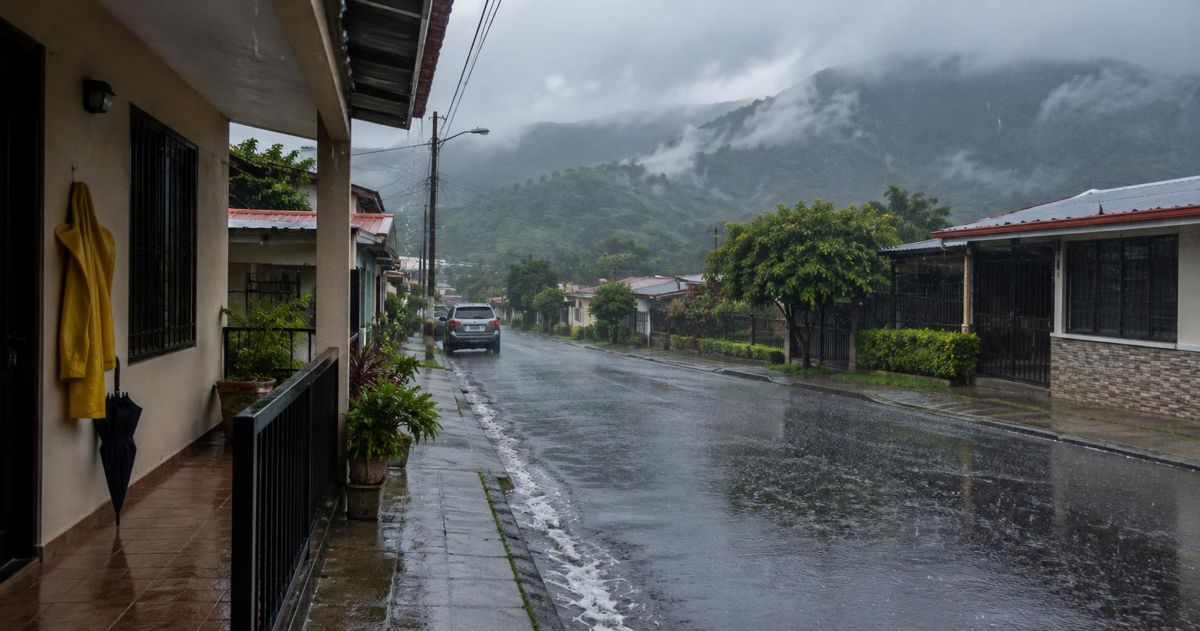
In Costa Rica, «invierno» (winter) is the name for the rainy season, not for cold weather. Here is how the National Meteorological Institute (IMN) defines it, when it starts in each region and how much it rains month by month.
How the rainy season is defined
The IMN does not speak of winter but of the rainy season. On the Pacific slope and in the Central Valley there are two well-marked seasons, dry and rainy; on the Caribbean slope, by contrast, there are no truly dry periods. To say when each one starts and ends, the IMN follows these steps:
- The threshold. It takes 80 millimetres of rain a month as the dividing line.
- The rule. It is the rainy season when at least three months in a row average 80 mm or more, and the dry season when they average 80 mm or less.
- The regions. To divide the country by its rainfall it used 727 stations with records from 1960 to 2013.
- The dates. To set when each season starts and ends it used daily rainfall from 1991 to 2020; the change must hold for at least ten days.
- The result. Each climate region has its usual start and end date, set by fortnight. In its climate outlooks, the IMN reports whether the rains come early or late against those dates.
Advertisements
Timeline of the rainy season
| When | What happens |
|---|---|
| April | The rainy season starts in the South Pacific; in the Central Valley it is a transition month |
| Second half of May | The rainy season usually sets in across the Central Valley |
| May | It starts in the North Pacific, where it arrives later and leaves earlier than in other regions |
| Around 24 June | The San Juan veranillo, felt most in the Central Valley and Guanacaste |
| July and August | Canícula or veranillo: the rains ease because the trade winds strengthen |
| 12 July to 14 August | The days most often dry where the veranillo is strongest (study of 1941 to 1980) |
| September and October | The rainiest months of the year |
| November | Transition towards the dry season |
| December | The dry season begins in the Central Valley and the North Pacific |
How much it rains, in figures
Juan Santamaría airport gets an average of 1,936.4 mm of rain a year, spread over 182 rainy days. September is the wettest month, with 345.4 mm, followed by October; from January to March it does not even reach 20 mm a month. July, the canícula month, gets 176 mm: less than June and August. According to the IMN, the rain usually falls in the afternoon and the early hours of the night.
| Figure | Juan Santamaría (Alajuela) | Daniel Oduber (Liberia) |
|---|---|---|
| Period | 2010-2022 | 2005-2025 |
| Average rainfall per year | 1,936.4 mm | 1,545.9 mm |
| Rainy days per year | 182 | 132 |
| Wettest month | September (345.4 mm) | October (338.7 mm) |
| Driest month | January (4.1 mm) | February (0.5 mm) |
| July, the canícula month | 176.0 mm | 119.6 mm |
Curious facts
- In Liberia, January and February do not even reach 1 millimetre of rain on average. The IMN describes the North Pacific as Costa Rica's most arid region, with much of its territory inside the Central American Dry Corridor.
- At Juan Santamaría airport it rains about 50 more days a year than at Liberia's: 182 against 132.
- The Western Valley is rainier than the Eastern one (about 2,300 mm a year against 1,700, in the 1961-1990 period), but the Eastern Valley has more rainy days.
- The Eastern Valley also holds the region's wettest spot: the Tseis station, in Orosi, Paraíso de Cartago, records more than 7,000 mm a year on average.
- The veranillo is not the same everywhere: the drop in rainfall is very marked in the north and centre of the Pacific slope, but not in the south.
Frequently asked questions
Is the rainy season a public holiday in Costa Rica?
No. It is a season of the climate, not a date in article 148 of the Labour Code, so it brings no day off and no special pay.
When does the rainy season start in Costa Rica?
It depends on the region. According to the IMN, it starts in April in the South Pacific, usually in the second half of May in the Central Valley and in May in the North Pacific, where it arrives later. These are average dates: each year they can come early or late.
What is the veranillo?
It is a drop in rainfall in the middle of the rainy season, when dry-season conditions return for a few days. It can last from a few days to several weeks and changes from year to year. The San Juan veranillo comes around 24 June; the canícula, in July and August.
Sources
- IMN: 2005-2023 Aeronautical Climatology, Juan Santamaría International Airport (table 1, 2010-2022 period).
- IMN: 2005-2025 Aeronautical Climatology of Daniel Oduber International Airport (table 1).
- IMN: estimated start and end dates of the rainy season by climate region, 1991-2020 period (2022).
- IMN: February to April 2022 climate outlook (order in which the rains start by region).
- IMN: June 2007 weather report (San Juan veranillo).
- IMN: “Los veranillos en Costa Rica”, Patricia Ramírez, research note no. 5 (data from 1941 to 1980).
- IMN: the climate of the Central Valley, Central Region (1961-1990 period).
Advertisements
More in Costa Rica calendar

Lifestyle, Costa Rica calendar
International Men's Day: history and figures for Costa Rica

Lifestyle, Costa Rica calendar
Blue November in Costa Rica: origin, history and figures

Lifestyle, Costa Rica calendar
Black Friday in Costa Rica: housing, loans and renting

Lifestyle, Costa Rica calendar
Costa Rica's Army Abolition Day: history and key facts
Most viewed in Lifestyle

Lifestyle, Urban and Suburban Spaces
Create an urban space that celebrates cultural diversity.

Lifestyle, Families and Housing
Find your ideal home with advice from local experts.

Lifestyle, Families and Housing
Discover how to choose a home that enhances your family happiness.
Lifestyle, Urban and Suburban Spaces
Urban refuge: spaces that promote social connection at home