


Costa Rica's Masquerade Day: history and key facts
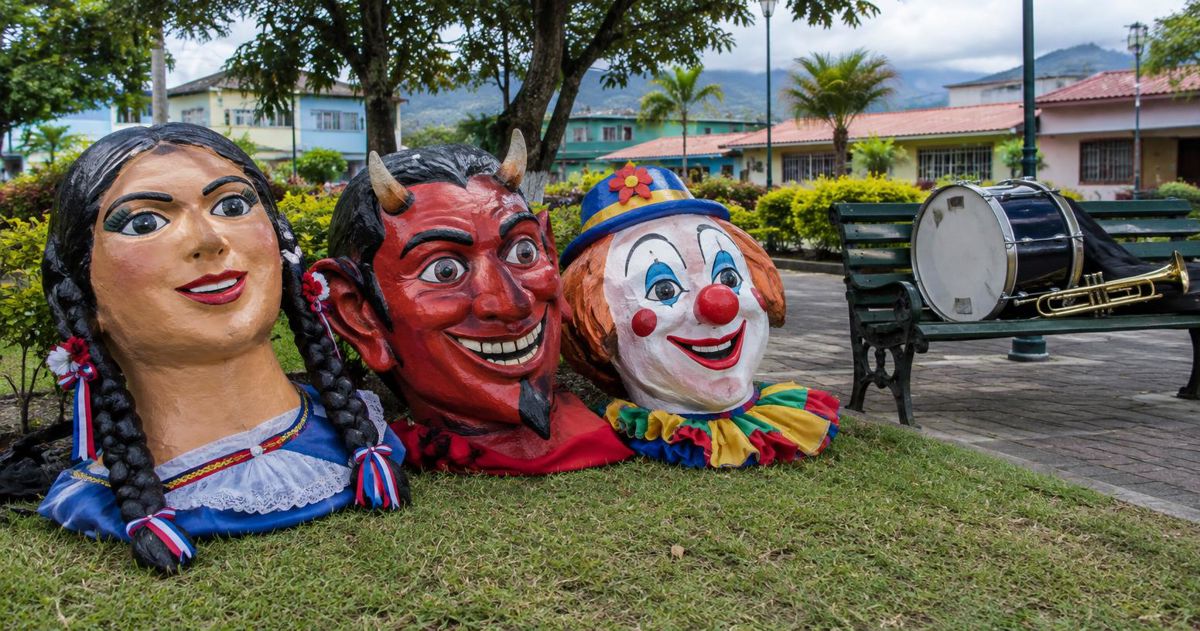
31 October is Costa Rica's Traditional Masquerade Day: giants, devils, cadejos and corner policemen taking to the streets to the beat of the cimarrona band. Here is how the date came about, the story of a Cartago masquerade family step by step and the laws that protect the tradition today.
How the tradition began, step by step
Masks may predate the arrival of the Spanish: the most notable tradition to survive is the Boruca devils' game, according to the explanatory memorandum of legislative bill 24,677. A well-documented history of the street masquerade is Cartago's, told by the mask-making brothers Avelino and Guillermo Martínez in the University of Costa Rica's Revista Herencia (2007).
- 1824, “Lito” Valerín is born. A gourd carver and musician from Cartago, he finds a Spanish-made head in the church and builds a “Giantess” on a wooden frame with it.
- 1887, the moulds. The clay and wooden moulds and the masks of his son, Jesús Valerín, date from that year; the Martínez family still kept them in 2007.
- 1910-1912, from earthquake to carnival. With the Cartago earthquake the masquerades vanish; in 1912, to lift spirits, Jesús Valerín organises Cartago's first carnival.
- 1942, the purchase. The Martínez brothers buy two giants and six masks from Valerín's last wife for 500 colones.
- 1978, to the State. Avelino Martínez sells his masquerade to the Ministry of Culture for 3,000 colones, bound for the National Museum.
- 2000, the first 31 October. Cartago's Colegio Universitario finds the 1996 decree and that 31 October the first Masquerade Day parade goes out, with the Martínez masks.
Timeline
| Year | What happened |
|---|---|
| 1824 | “Lito” Valerín, maker of his family's first “Giantess”, is born in Cartago |
| 1887 | Date of the Jesús Valerín moulds and masks kept by the Martínez family |
| 1910 | The Cartago earthquake makes the masquerades vanish |
| 1912 | Jesús Valerín organises Cartago's first carnival |
| 1942 | The Martínez brothers buy two giants and six masks for 500 colones |
| 1978 | The Martínez masquerade is sold to the Ministry of Culture for 3,000 colones |
| 1992 | Avelino Martínez creates the character Mr. Turpin |
| 1996 | Decree 25744-C declares 31 October Costa Rica's Traditional Masquerade Day |
| 2000 | First 31 October parade, in Cartago |
| 2022 | Law 10239 declares masquerades a national symbol |
| 2025 | The Ministry of Culture declares the San Miguel de Desamparados Masquerades of cultural interest |
| 2027 | 31 October falls on a Sunday |
The masquerade's laws and decrees
There are no official statistics on masquerades, but there is a legal trail that shows what is official and what is not. The 31 October date came from a decree, not a law, and a bill to give it the force of law is still before the Legislative Assembly.
| Year | Rule | What it provides |
|---|---|---|
| 1996 | Decree 25744-C, 9 December | Declares 31 October every year Costa Rica's Traditional Masquerade Day |
| 2021 | Decree 43302-C, 19 October (published on 19 January 2022) | Declares traditional cimarrona music intangible cultural heritage |
| 2022 | Law 10239, signed on 22 July and published on 18 August | Declares masquerades a national symbol; the Ministry of Education will include them in its curricula |
| 2024 | Bill 24,677, filed on 31 October | Proposes a statutory National Day of the Traditional Masquerade and the Costa Rican Cimarrona |
| 2025 | Committee report on bill 24,677, 16 September | Favourable committee report; no plenary vote |
| 2025 | Executive Agreement 87-C, 28 May | Declares the San Miguel de Desamparados Masquerades of cultural interest |
Law 10239 is short: besides declaring masquerades a national symbol, it empowers the Ministry of Culture to support initiatives that safeguard the tradition and asks the Ministry of Tourism and the Costa Rican Tourism Board to promote them to boost tourism. In its original text, bill 24,677 would add cimarronas as a national symbol and require 31 October to appear on every calendar circulating in the country.
Curious facts
- The Corner Policeman changed uniform with history: first he wore the outfit of the León Cortés and Ricardo Jiménez election contests, long-sleeved with big buttons; later, that of the 1948 war, green and short-sleeved.
- The first masks of Cartago's street parades were made of wire mesh and of paper with starch paste.
- The Upside-Down, who walks on his hands, was born from what Oreamuno mothers said when mosaic floors arrived: “Come in on your hands”, so no one walked in with muddy feet.
- The law that made masquerades a national symbol was not signed in San José but in Liberia, Guanacaste, on 22 July 2022.
- Cimarronas grew out of the philharmonic or municipal bands of the late 19th century, according to bill 24,677.
Frequently asked questions
Is 31 October a public holiday in Costa Rica?
No. It is not among the holidays in article 148 of the Labour Code nor on the Ministry of Labour's official 2026 holiday calendar. It is an ordinary working day; in 2027 it falls on a Sunday.
Is the masquerade cultural heritage?
The masquerade is a national symbol under Law 10239. What has been declared intangible cultural heritage is traditional cimarrona music, under Decree 43302-C.
Which characters appear in a masquerade?
The Ministry of Culture lists, among others, the Segua, the Giantess, the Cadejo, the Witch, the Policeman, the Baker and the Devil, plus masks made on the spot. In Cartago, the giants Julito and Julita and the dwarfs Beto and Berta are classics.
Sources
- Avelino Martínez and Guillermo Martínez: “¿Cómo nacen las mascaradas en Cartago?”, Revista Herencia, University of Costa Rica, vol. 20 (2007).
- Legislative Assembly: bill 24,677, “Creación del Día Nacional de la Mascarada Tradicional y la Cimarrona Costarricense” (2024), and its status on Delfino.
- Law 10239, “Declaratoria de las mascaradas como símbolo nacional”, La Gaceta 156 (18 August 2022).
- Ministry of Culture and Youth: Executive Agreement 87-C, “Mascaradas San Miguel de Desamparados” (28 May 2025).
- Ministry of Labour and Social Security: 2026 holiday calendar (4 December 2025).
More in Costa Rica calendar

Lifestyle, Costa Rica calendar
Blue November in Costa Rica: origin, history and figures

Lifestyle, Costa Rica calendar
International Men's Day: history and figures for Costa Rica
Lifestyle, Costa Rica calendar
Oxcart Day in Costa Rica: history of the carreta and figures

Lifestyle, Costa Rica calendar
Costa Rica's rainy season: month by month, with figures
Most viewed in Lifestyle
Lifestyle, Costa Rica calendar
Blue November in Costa Rica: origin, history and figures
Lifestyle, Costa Rica calendar
International Men's Day: history and figures for Costa Rica

Lifestyle, Pet-Friendly Housing
A home to live with pets: what to check before renting
Lifestyle, Costa Rica calendar
Oxcart Day in Costa Rica: history of the carreta and figures