


Driving in Costa Rica with a foreign license: the rules
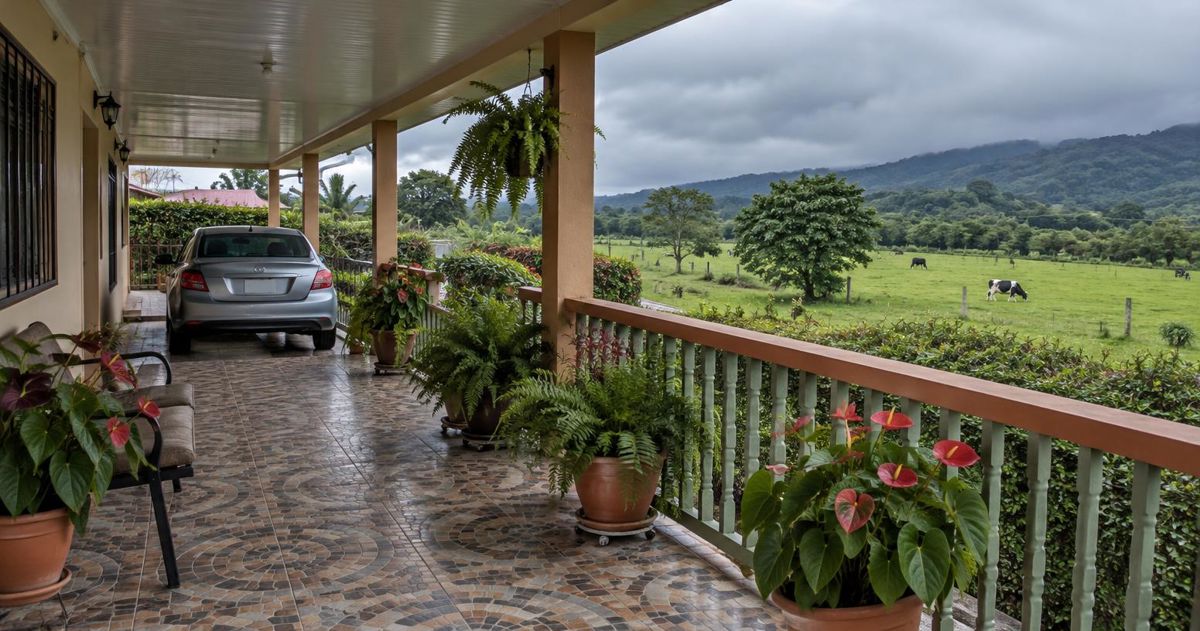
If you arrive in Costa Rica with a license from another country, the practical question is how long you can drive on it and what to do once you decide to stay. This guide answers that for tourists, digital nomads and residents, explains when it makes sense to bring your car or buy one here, and how transport should weigh in when choosing where to buy or rent a house.
How long is a foreign license valid in Costa Rica?
The rule is in article 91 of the Ley de Tránsito por Vías Públicas Terrestres y Seguridad Vial (Law 9078): if you are in Costa Rica under any of the stay subcategories of the Ley General de Migración y Extranjería, or in transit, you may drive on your foreign license the same type of vehicle it allows for a period equal to the one you were authorized to stay legally in the country. In other words, the license has no period of its own in Costa Rica: it inherits the period of your legal stay.
That has a practical consequence. The period that counts is the one you were authorized on entry, not the one you planned to stay. If that period expires and you remain in the country without another status, your foreign license no longer lets you drive, even if it is still valid at home. Keep your passport with the entry stamp or record, because that is what proves how long you were authorized. The same article also says you cannot be required to show a physical license if your country issues it in digital form.
There is also a rule for motorcycles. During that same period, if your foreign license is equivalent to the Costa Rican B-1 license or higher, article 91 of that law lets you ride, on non-primary roads, mopeds and combustion motorcycles of up to 125 cubic centimetres, or electric or hybrid ones of up to 11 kilowatts, and, on the same terms, three-wheelers and quad bikes of up to 500 cubic centimetres. It is useful in towns and beach areas, but it does not cover primary roads.
Advertisements
What changes if you drive as a tourist, digital nomad or resident?
The tourist is the simplest case: you enter under a stay subcategory and drive on your license for the authorized period. If you rent a car, the company will ask for your license and passport; on the road, the traffic officer may check that your stay is still valid. If you leave the country and come back in, the period depends on the new authorization you receive at the border or the airport, not on the previous one.
The digital nomad has an immigration status designed for people who work remotely for employers or clients outside Costa Rica. If your permit falls under a stay subcategory, the article 91 rule applies the same way: you drive on your foreign license for the authorized period. Confirm with the Dirección General de Migración y Extranjería which category your permit falls under, because that determines how long your license is valid.
The resident, or someone who has already applied for residency, follows a different path: the law allows you to drive as long as you obtain the Costa Rican license by homologation. You do not have to wait for a minimum period of stay to request it, so it pays to do it early, especially if you plan to buy a house outside urban centres and depend on a car from the first month.
How does a resident get a Costa Rican license?
Homologation converts your foreign license into a Costa Rican license of the equivalent class. Under article 91 of Law 9078, your foreign license must be valid, you must meet the law's requirements for that class of license except the basic road-safety course and the practical driving test, and you must prove your legal stay or that your application is in progress. In other words, you do not retake the driving test, but you do meet the rest of the requirements for that class.
- Check that your foreign license is valid; if it expires soon, renew it in your country before starting the process.
- Gather the document proving your approved immigration status or the receipt showing your application is in progress.
- Ask the Dirección General de Educación Vial about the current requirements for the class of license you will homologate and whether your license needs a translation or apostille.
- Meet the requirements of that class from which the law does not exempt you; the basic road-safety course and the practical driving test are not required.
- Submit the documents at your assigned appointment and collect your Costa Rican license.
While the process is under way, do not assume your foreign license keeps working indefinitely. The rule for residents makes driving conditional on obtaining the homologation, so the process should be a priority, not something for when there is time. An immigration lawyer or the Dirección General de Educación Vial itself can confirm which document from your immigration file serves as proof.
Is it better to bring your car from abroad or buy one here?
For a few years there was a clear incentive to bring it. Articles 5 and 12 of the Ley para la atracción de inversionistas, rentistas y pensionados (Law 9996) allowed those who requested them within the five-year window a one-time import of household goods free of tariffs and import taxes, and up to two land, air or sea vehicles free of import taxes, tariffs and VAT.
That window has closed. Counted date to date from its entry into force in July 2021, the five-year window to opt for those incentives ended in July 2026, under articles 5 and 12 of Law 9996 and article 15 of the Código Civil. Anyone arriving today as an investor, rentista or pensioner can no longer opt for them, and an imported car pays the ordinary import taxes.
With that, the math changes. Before shipping a car, ask a customs broker to calculate the taxes, freight, technical inspection and registration, and compare that with the cost of a similar vehicle on the local used market. Also consider whether the car suits the roads where you will live: a low sedan can be comfortable in the Central Valley and a problem on a gravel road in the rainy season. Buying here gives you familiar spare parts and workshops that already service the model.
| Aspect | Bringing it from abroad | Buying it in Costa Rica |
|---|---|---|
| Taxes | Pays the ordinary import taxes since the incentive ended | The local price already includes them |
| Paperwork | Customs, technical inspection and registration | Transfer before a notary and registration at the Registro Nacional |
| Spare parts | May be scarce if the model is not sold in the country | Models with local workshops and parts |
| Fit | May not be ready for gravel and rain | Chosen to suit the area where you will live |
How does transport weigh in choosing the area to buy in?
Your license and your car decide more than how you get around: they decide where it makes sense to live. In the Central Valley, much of daily life can be handled by bus, by train on some stretches or by taxi, and a house near a bus route lets you wait for the homologation without being cut off. Outside the Central Valley, in cantons such as San Carlos, Pérez Zeledón or those on the Guanacaste coast, a car is usually essential: distances to the supermarket, the clinic or the school are longer and public transport runs less often.
Measure the area by travel time, not by kilometres. Drive the route to your work, the school and the nearest hospital at rush hour before signing. In the rainy season, from May to November, check whether the road is paved or gravel, whether there are rivers or crossings that flood and whether a car without four-wheel drive can climb the slope of the driveway. When reviewing homes for sale in Costa Rica, note the real distance to those services alongside the asking price.
Transport also changes the price comparison. A remote area may have cheaper houses, but add a second car, more fuel and more hours on the road. Compare home prices in Costa Rica by canton with the cost of getting around from each one, and look at cheap homes for sale in Costa Rica with that full calculation in mind. If you do not know the area yet, renting first lets you test the routes: homes for rent in Costa Rica serve that purpose.
What we would do
- Write down the stay period you were authorized on entry: it is the same period during which your foreign license is valid.
- If you apply for residency, start the homologation as soon as your application is filed, without waiting for approval.
- Ask a customs broker for the full calculation before bringing a car, now that the Law 9996 incentive has ended.
- Rent for a few months in the area you are interested in before buying; cheap homes for rent in Costa Rica let you test the routes without committing much money.
- Choose the house by the real travel time to your services, not only by the asking price.
Frequently asked questions
Do you have to carry the physical license when driving?
Not necessarily. Article 147 of Law 9078 fines a driver who has no license, but says it is not necessary to carry it physically, since the traffic officer may confirm by other means that the permit exists. For foreigners, article 91 adds that you cannot be required to show a physical license if your country issues it in digital form. Even so, carry your passport or immigration document: it is what proves your stay period is still valid.
Can you ride a motorcycle on a foreign car license?
Only in certain cases. If your license is equivalent to the Costa Rican B-1 or higher, you may ride, on non-primary roads, mopeds and combustion motorcycles of up to 125 cubic centimetres, or electric or hybrid ones of up to 11 kilowatts, during your stay period. For larger motorcycles or for primary roads you need a license that allows that type of vehicle. Before renting a motorcycle at the beach, confirm with the company that your license covers it.
What happens if your stay period expires while you wait for residency?
If you have already applied for residency, the rule that applies to you is the resident's: you may drive as long as you obtain the Costa Rican license by homologation, and the law accepts the pending application as proof. That is why it pays to start the homologation early. If you have not filed an application and your stay has expired, your foreign license no longer lets you drive. An immigration lawyer can review your specific case.
This guide summarizes practice in Costa Rica as of November 2026 under the rules cited, and does not replace the advice of a lawyer or a notary, or a direct inquiry with the Dirección General de Educación Vial or Migración about your case.
Advertisements
More in Relocating to Costa Rica

Moving to Costa Rica, Relocating to Costa Rica
Costa Rica digital nomad visa: requirements and renting
Moving to Costa Rica, Relocating to Costa Rica
Bringing pets to Costa Rica: requirements step by step

Moving to Costa Rica, Relocating to Costa Rica
How to move your household to Costa Rica after Law 9996
Most viewed in Moving to Costa Rica

Moving to Costa Rica, Investing as a foreigner
Can foreigners buy property in Costa Rica?
Moving to Costa Rica, Relocating to Costa Rica
Costa Rica digital nomad visa: requirements and renting
Moving to Costa Rica, Investing as a foreigner
Buying a lot to build in Costa Rica: what to check

Moving to Costa Rica, Investing as a foreigner
Renting to tourists in Costa Rica: a guide for foreign owners