


Buying a lot to build in Costa Rica: what to check
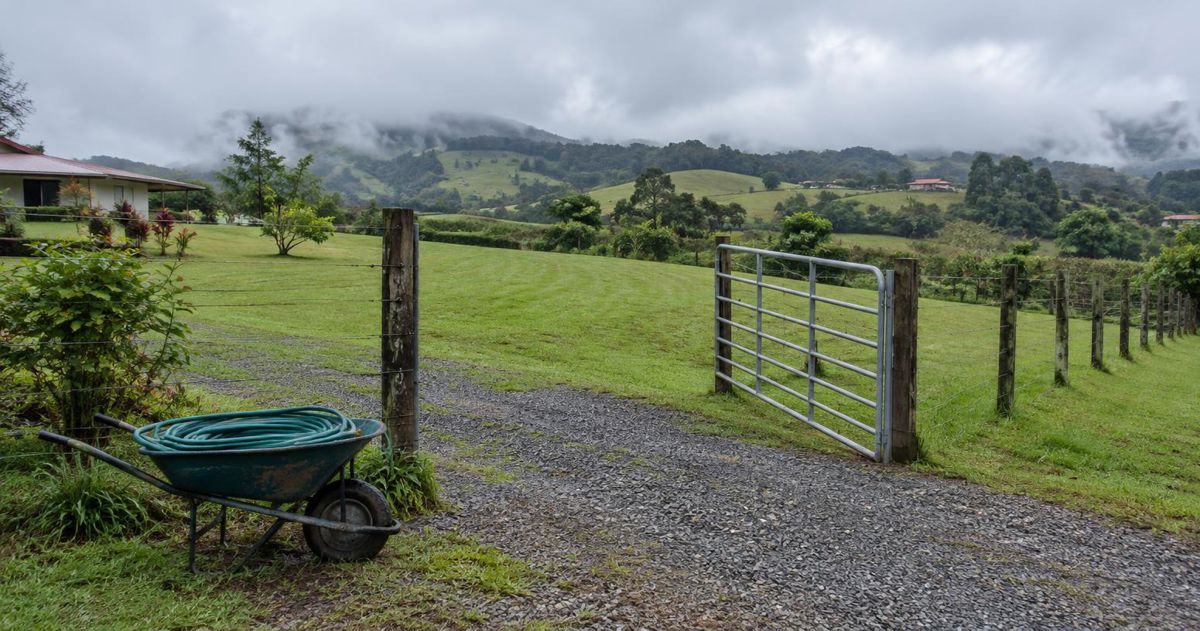
Buying a lot to build a house in Costa Rica is, above all, buying the chance to obtain a permit. This guide is for the foreigner who wants to build and does not live in the country: what to check on the land before signing, why water decides the purchase, what the municipality requires and how to oversee the build from abroad without losing control.
What should you check on a lot before buying it?
| Type | Median | Typical range | Price per m² of land | Listings |
|---|---|---|---|---|
| Lots | US$167k | US$87k – US$400k | US$110 | 3,383 |
The table in this section shows the asking prices for lots across the country this month, and the breakdown by province and canton is on the page of land prices in Costa Rica. But the asking price says little about what matters to someone who wants to build: whether the land allows a house. That answer is not in the listing but in three tests: the recorded survey plan, the land-use certificate and access to a public road.
Start with the plan. Under article 30 of the National Cadastre Law (Law 6545), except for cases such as mortgage cancellations, every registry entry on a property must cite a survey plan, no survey plan has legal effect unless it is recorded in the National Cadastre, and the Registry suspends the recording of any document that lacks a recorded (catastrado) plan. In practice, without a recorded plan the purchase deed is not registered. Compare the plan with the land: boundaries, area and frontage must match what you see on site.
If the lot came from splitting a larger property, ask about the municipal approval. Articles 33 and 34 of the Urban Planning Law (Law 4240) require, to subdivide land in an urban district or other area under planning control, a plan approved (visado) by the municipality, issued free of charge within 15 days of filing. Public offices that grant building permits, utility services or loans treat subdivisions made without that approval as non-existent. A poorly subdivided lot can look attractive in the listing and still be useless for building.
Next, land use. Article 28 of Law 4240 prohibits using land for a purpose incompatible with zoning and requires a municipal certificate showing that the use conforms. Articles 6 and 102 of the INVU Building Regulations (Reglamento de Construcciones), which apply where the municipality has no rules of its own, state that you need that certificate to design and build, and that it must state at least the permitted use, setbacks, coverage, density, height, frontage, minimum area and its period of validity. Get it before paying: it tells you what house fits on that lot.
Access is the third test. Article 58 of Law 4240 says the municipality will not allow construction when the work does not conform to zoning, when the lot came from a subdivision without an approved plan, or when the land lacks urbanization requirements or adequate access to a public road. A right of way across the neighbouring property, or a road whose public status nobody has confirmed, deserves a notary's review before you sign.
| Document | Issued by | What it tells you |
|---|---|---|
| Recorded survey plan | National Cadastre | Area, boundaries and that the purchase can be registered |
| Municipal plan approval | Canton municipality | That the lot's subdivision is valid |
| Land-use certificate | Canton municipality | What and how much you can build |
| Water availability certificate | AyA, ASADA, operator or MINAE | That the house will have water service |
Advertisements
Why does water availability decide the purchase?
In Costa Rica, a lot with a good view and no water is a lot where you cannot build. Article 117 of the INVU regulations states that every building must have water service available and that you must obtain the document proving it: a certificate from AyA, the ASADA or the service operator. If the house will be supplied by a well, spring or natural source, the document is the availability document or water-use concession from MINAE's water department, with potability tests.
That is why the water certificate comes before the purchase, not after. In many rural areas the service is run by an ASADA, the community association that manages the local water system, and its capacity to connect new houses varies from one community to another. Ask the seller for a current certificate or request it yourself with the recorded plan, and make the purchase conditional on a positive answer. Among the cheap land & lots for sale in Costa Rica there are plots far from the network: check the water before the price.
The certificate also expires. For a single-family house, articles 37 and 38 of AyA's water and sewerage service regulations provide that AyA's positive availability certificate is valid for 12 months and can be extended up to a maximum of 24 consecutive months if you show concrete steps on the project. The extension must be requested within the last quarter of validity or the certificate lapses, and any change of use or mismatch with what is built voids it. If your design runs late, put that date on your calendar.
What permits does the municipality require to build?
Article 74 of the Building Law (Law 833) and article 57 of Law 4240 provide that every construction work carried out in the country's towns, permanent or temporary, requires a licence from the municipality, and that building contrary to the law, the regulations or the municipal permit is prohibited. The licence is requested from the municipality of the canton where the lot is, and your professional files it with the sealed plans.
Before granting the permit, under article 102 of the INVU regulations, the municipality must check that the work conforms to the land-use certificate and is not in an area vulnerable to natural hazards. That is where slope, proximity to a river or land that floods matter: review them with your professional when you visit the lot, not when you apply for the licence. The usual order of the process is this:
- Obtain the recorded survey plan and, if the lot comes from a subdivision, confirm the municipal plan approval.
- Request the land-use certificate from the canton's municipality.
- Obtain the water availability certificate from AyA, the ASADA, the operator or MINAE.
- Hire a CFIA engineer or architect and record the contract with the association.
- File the sealed plans, with the construction stamp, to obtain the municipal licence.
- Build according to the approved project and give notice of completion before occupying the house.
Without a licence it is not worth even starting. Articles 88, 89 and 92 of Law 833 treat building without a prior licence, changing the approved project or occupying the building before giving notice of completion as offences, and allow the municipality to punish them with fines, closure, eviction or demolition. Those penalties can fall on you as owner, on the responsible engineer or on the contractor, so a shortcut in the paperwork can end in a demolition.
How do you oversee the build if you live abroad?
Building from abroad is possible, but not by remote control with a trusted foreman. Under article 83 of Law 833 and article 6 of the INVU regulations, only an engineer or architect who is a registered, practising member of the CFIA can authorize a building-licence application, and the professional who files it must supervise the work. That professional is your first line of control: choose them before buying the lot, so they can review the land and the land-use certificate with you.
The contract with that professional is not an informal agreement. Articles 53 and 54 of the Organic Law of the Federated Association of Engineers and Architects (Law 3663) require it to be made on the CFIA's forms and recorded there. No construction plan can be processed by public offices without the CFIA's seal, which is not given unless the contract is recorded and the construction stamp is attached, and every plan must be signed and carry the responsible professional's registration number. Ask for a copy of the recorded contract and confirm with the association that the professional is in good standing.
During the build, article 9 of the CFIA regulations on engineering and architecture consulting contracts requires you, as owner, to hire a construction-execution manager (REC) and an inspection service, or instead a works director, all registered with the CFIA. The inspector must visit the site at least every 7 calendar days. For someone living abroad, that visit is the backbone of control: ask for each one to come with photos, progress and pending items in writing.
Local support also helps with the purchase itself. Among the real estate agents in Costa Rica there are people who know each area's municipality and ASADA and can make enquiries before you travel. To sign without being in the country, the usual route is a power of attorney granted before a notary; ask yours what scope you need and who will use it.
What do the plans, the association stamp and the licence cost?
The process has several costs worth separating. The first is the professional's fees for the plans, the design and the inspection or direction of the work, agreed in the contract recorded with the CFIA. The second is the association's construction stamp. The third is what the canton's municipality charges for the licence, an amount you should ask about there, together with the permit's period of validity, which under article 83 of Law 833 the municipality also sets.
As for the stamp, article 57 of Law 3663 provides that every construction plan filed for approval carries a CFIA construction stamp of half of 1 per thousand of the work's value if it is worth up to ₡100,000.00 and 1 per thousand if it is worth more. No state office or municipality accepts plans without the CFIA seal and that stamp. It is a small cost next to the build itself, but without it the file does not move.
| Cost | Charged by | When it is paid |
|---|---|---|
| Recorded survey plan | Surveyor and National Cadastre | Before the purchase, if the lot lacks one |
| Professional fees | Engineer or architect | As set in the contract recorded with the CFIA |
| Construction stamp | CFIA | When filing the plans for approval |
| Building licence | Canton municipality | Before work begins |
Add these costs to the lot budget from the start. When you compare land & lots for sale in Costa Rica, keep in mind that sloping land, land without paved access or land far from the water network makes the design and the build more expensive, even if its asking price is lower.
What we would do before signing the purchase
- We would filter by budget first, for example among the lots for sale in Costa Rica under US$50,000, and rule out any without a recorded survey plan.
- With a larger budget, we would review the lots for sale in Costa Rica under US$100,000 with the same checklist: plan, approval, land use and access.
- We would make the purchase conditional on a positive water availability certificate.
- We would hire the CFIA professional before buying, so they can review the land and the land-use certificate.
- We would ask for a written report with photos from every inspection visit.
Frequently asked questions
What changes if the lot is near the beach?
Almost everything. Under articles 9 and 10 of the Maritime-Terrestrial Zone Law (Law 6043), the maritime-terrestrial zone is the 200-metre strip along the Atlantic and Pacific coasts, measured horizontally from the ordinary high-tide line, and it is split into a 50-metre public zone and a restricted zone made up of the remaining 150 metres. Inside that strip you do not buy an ordinary lot, unless the land is a property validly registered in a private name: the public zone cannot be occupied, and in the restricted zone what you obtain is a municipal concession for a term. Before making an offer, have a surveyor place the lot against the public-zone markers set by the National Geographic Institute, and have your notary check whether what is being sold is a registered property or a concession.
Can you build two houses on a small lot?
Not always. Article 58 of Law 4240 prevents building more than one house on a lot at or below the minimum size. If your plan is a main house and a second one to rent out or for your family, the land-use certificate will tell you the minimum area, coverage and density that apply to that lot. With that information your professional will know whether the project fits or whether it is better to look for a larger plot before buying.
What happens if the water certificate comes back negative?
Since every building must have water available, without it the project does not move until the supply is resolved. The alternative is a well or spring with MINAE's availability document or concession and its potability tests, a process that takes time and does not always succeed. That is why we recommend making the purchase subject to that certificate in the purchase option or the agreement prior to the deed, with your notary's support.
This guide summarizes practice in Costa Rica for buying a lot and building, with the rules it cites as in force in November 2026. It does not replace the advice of a lawyer or a notary, who should review the registry search, the plan and the conditions of your lot before you sign.
Advertisements
More in Investing as a foreigner
Moving to Costa Rica, Investing as a foreigner
Renting to tourists in Costa Rica: a guide for foreign owners
Moving to Costa Rica, Investing as a foreigner
What you actually buy near the sea in Costa Rica
Moving to Costa Rica, Investing as a foreigner
How to buy a house in Costa Rica without travelling
Moving to Costa Rica, Investing as a foreigner
Buying a house through a corporation or in your own name
Most viewed in Moving to Costa Rica
Moving to Costa Rica, Relocating to Costa Rica
Costa Rica digital nomad visa: requirements and renting
Moving to Costa Rica, Investing as a foreigner
Renting to tourists in Costa Rica: a guide for foreign owners
Moving to Costa Rica, Investing as a foreigner
What you actually buy near the sea in Costa Rica
Moving to Costa Rica, Retiring in Costa Rica
How to rent in Costa Rica as a foreigner